

How can I help my business to survive the increased disruption caused by COVID 19?
 In the last month, the world has changed.
Every 24 hour period brings about new information, and yet there are questions that no one can answer.
- “How long will the outbreak go on for?”
- “When will the social distancing end?”
- “What will happen to my business if it has to continue with people working remotely?”
It is easy to understand how anxiety can grow in these uncertain times. What if there was a way to make your business less sensitive to some of those uncertainties? Whenever there is disruption, the organisms that adapt to the new environment fastest are the ones that survive. While the global pandemic is a tragedy unfolding, there will also be time it will end and some businesses will emerge stronger as a result of finding solutions to cope with the new normal. If you would like to learn more how to, please read more or contact us through the buttons below…
Will we ever get back to NORMAL?
Would that even be the right thing to do?
 During the COVID-19 outbreak the world has changed at a faster pace than ever.
Many have struggled, all have learned…
Back to “Normal” would be a waste of all this learning. If we look beyond the resistance to change and the uncomfortable feelings provoked we must admit that many new potential standards have been born during the crisis management. The water in the Venice channels haven’t been cleaner in the last decades, air pollution haven’t been less in the same period on a global scale. Traffic jams were rarely seen, less traffic accidents have happened. Kids have been eating at home with both parents at the same time, we have spent more time talking to each other than ever before in OUR lifetime.
Many seniors in our community remember all these conditions from a long time ago.
If you would like to learn more about how your future standards could look like in a future proof company, then please read more or contact us through the buttons below…
How can I manage the performance of my team when they are working remotely?
 Maybe the first thoughts are: Maybe I should not… I trust them, let them find their way… It is difficult enough as it is… This will not last forever anyway…
The second thought might be: Maybe I should… I do not want them to let the focus slip… I need to provide them direction…
How do I know how many hours they are really working?
Anyway, we are now having a totally new reality forced upon us in just a matter of days…
So the probability of the set up not being really efficient is very high. We are still inventing how to do it optimally. Actually there are 3 different dimensions we need to take into account when we want to manage this:
- The type of work the people do remotely now.
If a person is working all day on a customer portfolio and processes account per account all day long, there is historical data/experience available on how many account on average per day can be handled. (and of course there is always variance, but we can put a rough number on it.)
At the other hand the work can have a totally different nature and we need to measure it in a completely different way.
Many more different types of work. - The type of person who is doing the work.
A self-starter, very disciplined, not so structured, extremely focused, easily distracted, in need of frequent help or coaching. There are many characteristics which work or do not work so well in a remote setting. - The amount of interactions and information handovers which are needed to do the job.
Basically if you have good transparency on all 3 you can design the right way how to manage your remote teams… If you would like to read more about how to do this please click below. You can also schedule directly a call with one of our experts to get a free of charge session on this topic to see what are your challenges and chances to design a future proof way of working… Please leave your contact details below if that is what you would like to do…
Forget Continuous Improvement. I just want to survive!!
 In pre Covidian times, the continuous improvement programme was working well, improving quality, reducing lead time and reducing cost. The Return On Investment (ROI) was healthy and even the culture was starting to move towards a more positive one.
Then at the start of 2020, the pandemic took hold and all of a sudden, the world is a different place. The carefully crafted Continuous Improvement strategy seems like it could be torn up – the challenges being faced today were not even in the most unlikely rows of the risk assessments. It is not a question of whether the lead time can be improved by 5% over the previous year, but how to manage a now even more remote supply chain that has gaps and is struggling itself to keep going. Some team members will be sick, some will be isolating and others could be caring for family members. All in all, maintaining the status quo will be tough, let alone making improvements. So the current focus is solely on surviving.
It must be time to stop Continuous Improvement activity and divert team members to help other areas that are short of staff, right?
Wrong.
Survival is the minimum requirement of this situation. Thriving is the desired outcome. These are the times when it is necessary to review the new current state, adjust the strategy and put in plans to deliver a new improvement plan that reflects the new normal. Does a change in current state mean that you should abandon the improvement system that has delivered so much, or should you use that same system to enable to overcome the issues that have now arisen and make the business stronger and more robust to future risks.
How do I maintain a Continuous Improvement culture when people are working remotely?
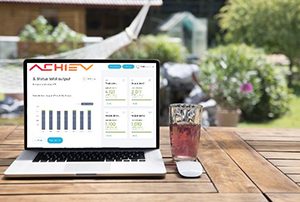 When you have a good system in place the work will also continue when the boss is not looking. Why? Not because people feel forced to do so, no because they want it.
Because in the definition of AchieV a good system means:
- People own Continuous Improvement in their own circle of influence.
- If an opportunity lies outside their own circle of influence they escalate it to someone who has larger circle of influence, and this continues until the problem finds someone who can fix it efficiently.
- People know exactly what the expectations are and they are always looking for opportunities to hit or exceed the targets. They do not accept the status quo and are always looking for opportunities to excel.
If this is in place and the people enjoy contributing to the success of the business and they feel recognized for their efforts, the role of the boss is to offer help to accomplish improvements and to develop his people.
Of course AchieV promotes the manager on the shop floor to develop and foster this great CI Culture, but in times of Covid-19 this is not our current reality. So how to do this remotely? Please read more to find out how or directly contact one of our experts to talk about your specific situation and get some help to succeed with developing the Continuous Improvement Culture in your company. Why not? It’s for free!
What are my standards in times of chaos?
 “The ultimate measure of a man is not where he stands in moments of comfort, but where he stands at times of challenge and controversy.” Martin Luther King, Jr.
And this is how people in an organization will look at the leadership of that organization in times of crisis and chaos. It is very easy to end up in chaos when something disruptive comes along as COVID-19. Your customer demand is changing as never before, your supplier are not sure about their business continuity, your own task-force can not work anymore as they were used to, some might be sick…
And this is exactly when the difference is made between the true leaders and the ones who are not there yet.
The most important behavior of a leader to show true leadership is to have consistent behavior. If you are a constant display of balance, motivation, confidence and give direction and comfort to those who are seeing you as their leader and role model, only then you will be seen as a true leader.
When in an organization and its processes the standards are not yet fully in place, and people might be suffering from the lack of clarity, risk is entering into their workplace. Because lack of clarity makes people improvise in uncommon situations. Improvising means that variance is introduced in the execution of the work-processes and the outcome becomes unpredictable. This means the risk is increasing, risk for safety, risk for quality and risk for stable operations.
The solution lies in having the right standards in place, where many think standards are increasing inflexibility and hindering adaptability to crisis situations, our opinion is that having the right standards is enabling you to change the standards fast to new circumstances…
If you recognize this scenario in your organization or would like to know more about how new standards can help your organization to adapt to COVID-19 challenges, if you would like to know more about how to manage the new risks in the most efficient way, please schedule a free call with one of our experts below. Or read more by clicking on below button.
Get in touch with us for more information.
